Earley Lab — Quantum Information Chemistry
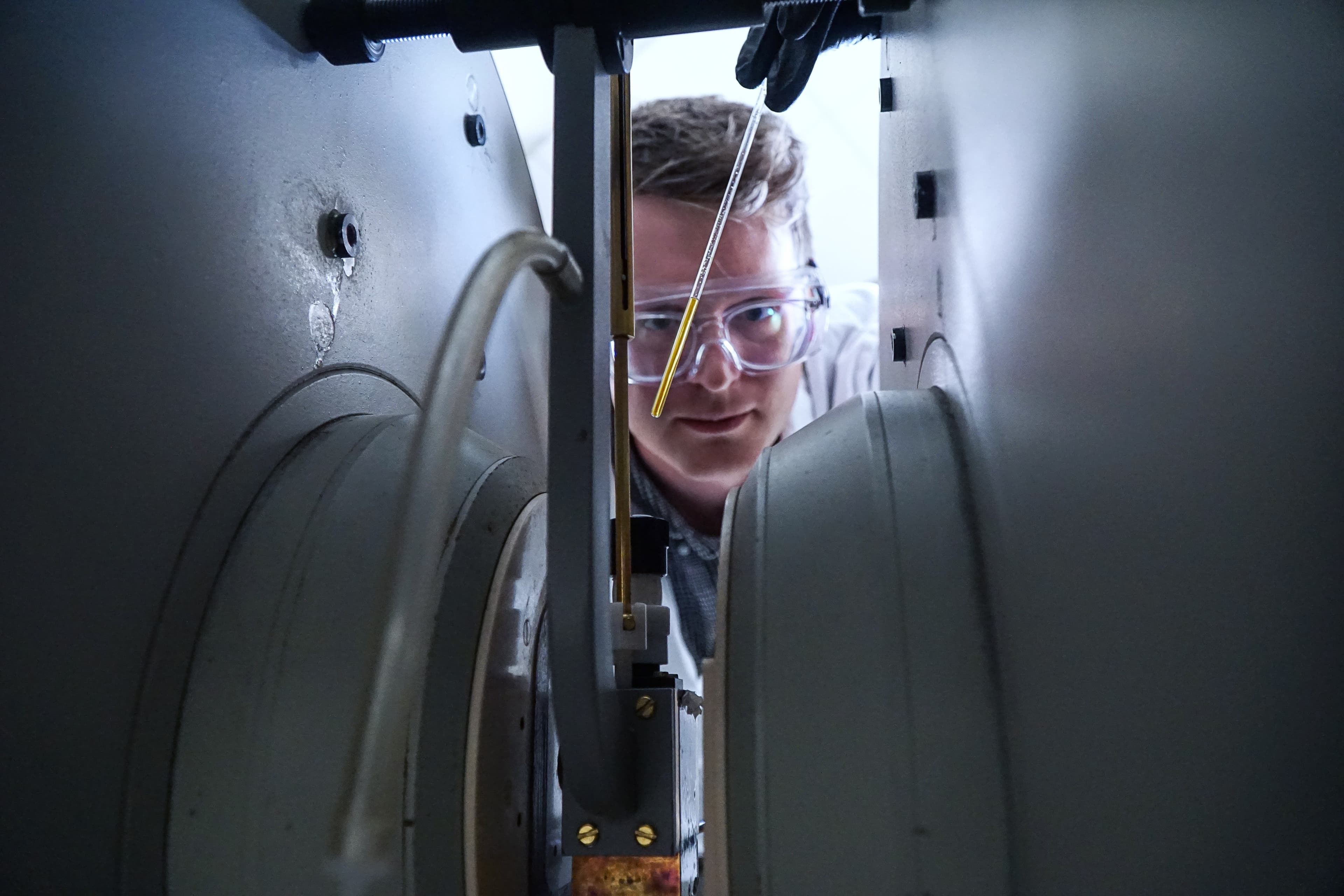


We explore how molecular structure shapes quantum and spin behavior, developing new spectroscopic approaches to illuminate quantum phenomena in chemical systems.
We explore how molecular structure shapes quantum and spin behavior, developing new spectroscopic approaches to illuminate quantum phenomena in chemical systems.

Justin joined the School of Molecular Science at Arizona State University in 2024. He received his B.S. in chemistry from the University of Wisconsin - Madison working on coherent multidimensional spectroscopy under the direction of Professor John Wright and Blaise Thompson, Ph.D. Afterwards, he pursued his Ph.D. in physical chemistry at the University of Colorado Boulder joint with the National Renewable Energy Lab on the development and implementation of time-resolved dielectric-loss spectroscopy under the advisement of Professor Garry Rumbles and Professor Obadiah Reid. After graduate school, Justin moved to the department of Mechanical Engineering at University of Colorado Boulder as a postdoctoral fellow working under Professor Greg Rieker on the development of longwave infrared dual comb spectroscopy. Justin is driven by the pursuit of designing measurement technologies to unearth impactful chemistry insights and translate these technologies into real-world applications. He believes quantum information chemistry, particularly quantum molecular sensing, will revolutionize detection and is eager to expand its boundaries.

Postdoctoral Scholar
Ph.D. CSIR-IMMT India

PhD Student
2nd year

PhD Student
1st year

PhD Student
1st year

Undergraduate
Aerospace Engineering (Astronautics) B.S.E.

Undergraduate
Chemical Engineering BSE

High School Sophomore
Gary K. Herberger Academy
Molecular qubits take the fundamental concept of a quantum superposition of |0⟩ and |1⟩ states and encode it directly into the structure of individual molecules. Rather than engineering quantum states in solid-state devices, trapping atoms with complex laser systems, or photon-fields, molecular qubits harness the intrinsic quantum properties that molecules naturally possess such as electron or nuclear spins. This means we can use the precision tools of synthetic chemistry to literally design and build quantum systems from the ground up.
What makes this molecular approach so powerful? Traditional quantum systems often require extreme conditions: near absolute zero temperatures, ultra-high vacuum, or complex cleanroom fabrication. Molecular qubits, by contrast, can be chemically tailored to optimize their quantum behavior by modifying ligand environments, adjusting the molecular geometry, tuning orbital overlap, or enhancing luminescence.
The potential for molecular qubits is immense with the versatility and scalability chemistry brings. Molecular qubits can operate under milder conditions than many alternatives, making them particularly attractive for quantum sensing applications where you need to detect magnetic fields, temperature changes, or chemical environments in real-world settings. Plus, synthesizing millions of identical molecules is routine chemistry, opening pathways to scalable quantum technologies.
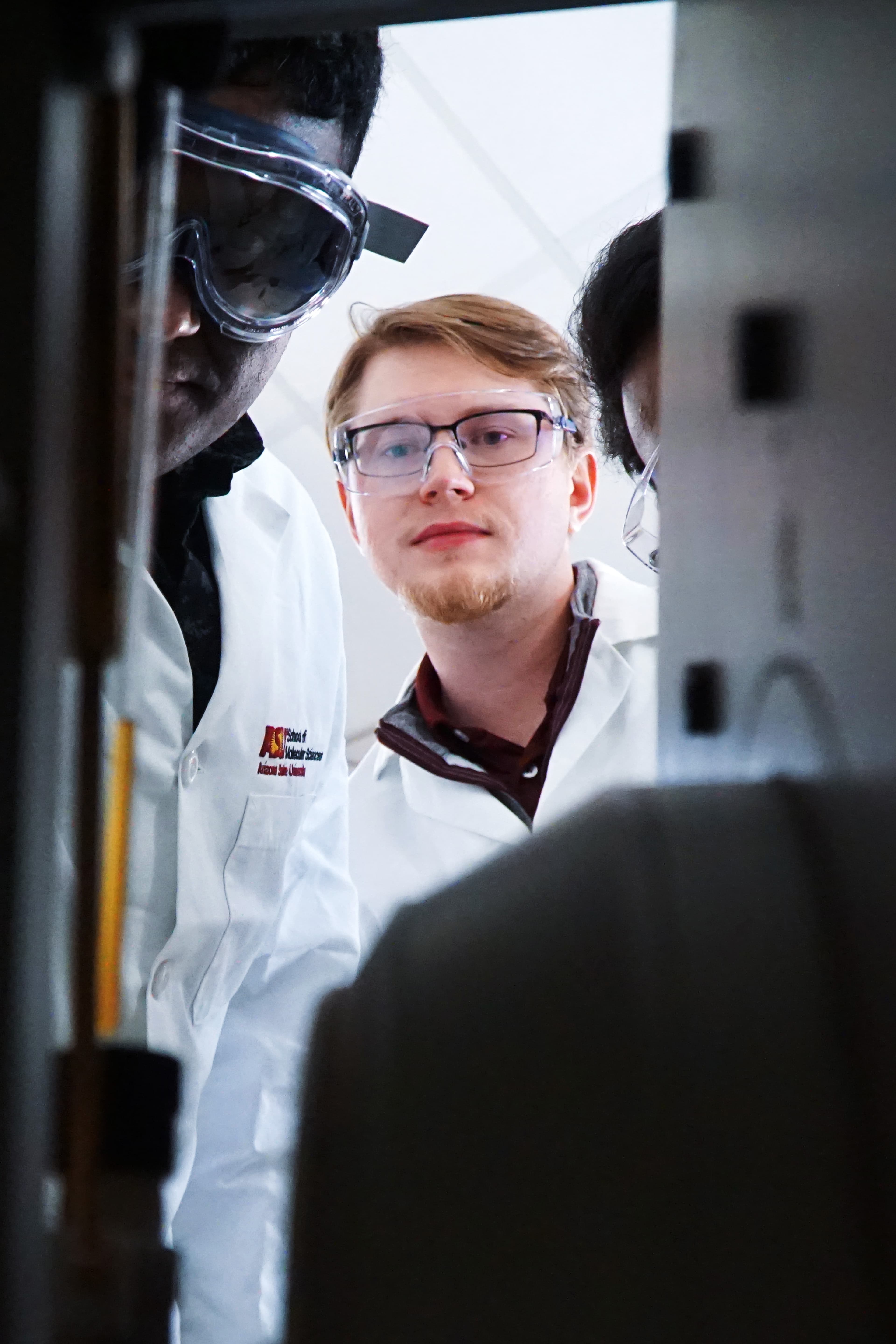
Research in the Earley Lab focuses on understanding and controlling molecular qubits at multiple levels. We investigate intramolecular effects such as how the internal structure and electronic environment of individual molecules influence their quantum properties. We study intermolecular effects such as exploring how molecular qubits interact with each other and their surroundings, including the development of molecular qubit arrays for creating entangled quantum systems. Additionally, we develop advanced magnetic spectroscopy techniques to probe and characterize these quantum states with unprecedented precision. Lastly, we apply quantum sensors to study chemical systems, probing electron, energy, and ionic transport processes as well as molecular configuration and identity.

J.D. Earley, O.G. Reid, T.L. Murrey, E.A. Doud, A.M. Spokoyny, M.A. Hermosilla-Palacios, G. Rumbles, A.J. Ferguson, and J.L. Blackburn.

M. A. Hermosilla-Palacios, S. Lindenthal, J. D. Earley, T. J. Aubry, D. DeLuca, H. Al Khunaizi, A. M. Spokoyny, J. Zaumseil, A. J. Ferguson, & J. L. Blackburn

M. Kudisch, R.X. Hooper, L.K. Valloli, J.D. Earley, A. Zieleniewska, J. Yu, S. DiLuzio, R.W. Smaha, H. Sayre, X. Zhang, M.J. Bird, A.A. Cordones, G. Rumbles & O.G. Reid
![A scientific figure illustrating electrostatic work effects in ionic photoredox catalysis in low dielectric constant solvents. The image shows ion pair interactions between [Ir(IV)]⁺ (red sphere) and [BArF₄]⁻ (teal sphere) complexes in different oxidation states, connected by arrows indicating high ε₃ solvent conditions. A central molecular structure shows an iridium complex with CF₃-substituted ligands in a gray circular region. The diagram demonstrates how electrostatic interactions change in low dielectric environments, with molecular structures of various substrates shown around the periphery. The figure emphasizes the role of ion pairing and electrostatic work in determining reactivity patterns when the dielectric constant of the solvent is low.](/_next/image?url=%2F_next%2Fstatic%2Fimmutable%2Fmedia%2Fjphyschemb2025.448y8877r5_90.png&w=3840&q=90)
J.L. Ratkovec, J.D. Earley, M. Kudisch, W.P. Kopcha, E.Y. Xu, R.R. Knowles, G. Rumbles, O.G. Reid

